
- 28 July 2026
- Michael McGrath

Ronald Reagan is remembered for a phrase that has become almost a political cliché: freedom is not free. [1] He was speaking about liberty in the geopolitical sense, but the same observation applies equally to markets.
A free market is not a law of nature. It is a carefully constructed system that exists only where property rights are protected, contracts are enforced, courts are trusted, and governments provide sufficient stability for people to invest, innovate and build businesses with confidence. The freedom to create wealth is itself a form of liberty, and like every other liberty, it depends on institutions that must be maintained rather than assumed.
That is the case for the free market.
I have spent the latter a career at the table with founders helping to sell the businesses they spent decades building, watching value get priced, and then unlocked at the moment of sale. I believe in the system. And yet I keep returning to an uncomfortable question: are we letting the market run with too little restraint or even understanding of where it’s is leading us?
I was recently reading a piece on this in the Australian Financial Review, and it got me thinking about the free market. [2] Consider the data. A recent survey of roughly 7,000 billionaires assembled over the past 25 years found something genuinely encouraging: for the first time, half of all billionaire wealth is now reasonably fairly earned, up from a far smaller share in the early 2000s, while the portion tied to “uncompetitive” sectors — those dependent on political access such as gambling, construction, and raw materials — has actually declined since 2021.[3] Billionaires, in other words, look less like policy failures than they used to. That should complicate the reflexive “eat the rich” politics now fashionable in the liberal west.
But it does not answer a deeper question about fairness and equity.
Many of the world’s largest technology companies generate enormous revenues from consumers spread across dozens of countries while reporting much of their profit in jurisdictions offering the lowest tax burden. A customer in Sydney, Paris or Jakarta buys advertising, subscriptions or digital services, yet much of the resulting profit may ultimately be taxed somewhere entirely different.
Governments have recognised the problem. The OECD’s Pillar One reforms were designed to allocate part of multinational profits to the countries where customers actually live rather than simply where intellectual property or headquarters happen to be located. Years of negotiations, however, have produced limited progress, while unilateral digital taxes have often resulted in trade disputes rather than lasting solutions. [4]
The issue is remarkably difficult to solve. Yet it remains difficult to escape the sense that something about the current arrangement feels incomplete.
These questions are hardly new.
In 1991, in the encyclical Centesimus Annus, Pope John Paul II offered a critique of the post-Cold War moment that is now largely forgotten, partly because it was inconvenient to everyone. He did not simply laude the failure of communism. He warned of the risk of an “idolatry” of the market, and drew a sharp distinction between a free economy operating within a strong ethical and legal framework, which he judged legitimate, and one in which economic freedom is left to answer to nothing beyond itself, which he did not. It is a critique that cuts against both the socialist and the libertarian instinct, which may be exactly why it never found much traction in the liberal West – we thought we’d won and that was that![5]
Executive remuneration tells a similar story.
In 1965, the average chief executive of a large American company earned around 21 times the salary of the typical employee. [6] Today that multiple is closer to 280. Since the late 1970s, CEO pay has risen by well over 1,000 per cent, while typical worker compensation has grown only modestly, despite substantial gains in productivity. [7]
Markets did not produce that outcome in isolation. Boards, remuneration committees, consultants and shareholders collectively accepted it, year after year. Whatever one thinks of those decisions, they were institutional choices as much as market outcomes.
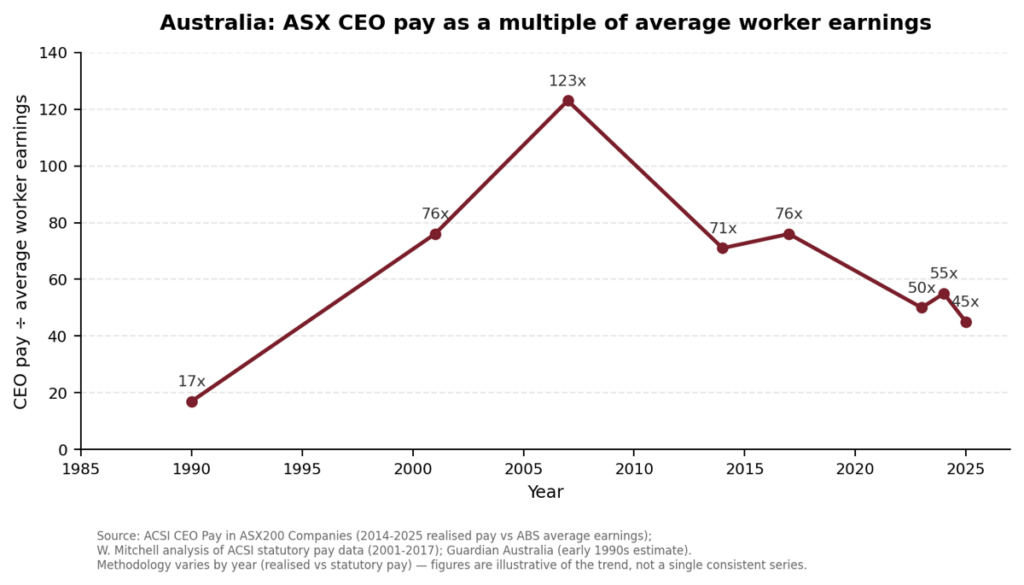
The same pattern shows up closer to home. Australian CEO pay has followed a similar arc: from around 17 times an average worker’s pay in the early 1990s, to a peak above 120 to 1 in 2007, before easing back to somewhere between 45 and 55 to 1 on the latest realised-pay measure. It is a narrower gap than in America, but the direction of travel, driven by bonuses and share incentives boards have been reluctant to restrain, until quite recently has been much the same.
None of this is an argument against wealth creation or entrepreneurship. The evidence increasingly suggests that many of today’s great fortunes have been earned through genuine innovation rather than political patronage.
Nor is it an argument for abandoning capitalism in favour of systems that history has repeatedly shown to be less effective.
It is, however, an argument for recognising that markets are not self-correcting moral systems. They require rules, trusted institutions and public confidence if they are to remain legitimate. Economic freedom is strongest when accompanied by accountability.
I do not pretend to have easy answers.
Should taxation follow where economic value is created rather than where profits are booked? Should shareholders demand greater justification for widening executive pay ratios? How do we preserve the dynamism of capitalism while ensuring that its rewards continue to command public trust?
These questions have ideological, moral and practical implications.
If freedom is not free, neither is the free market. It survives only because societies choose to sustain the institutions, laws and ethical boundaries that make it possible. Perhaps defending capitalism today requires not less reflection about its limits, but more. My own view is that the global tech giants and in particular the recent widespread introduction of AI is starting to resemble utilities rather than mere goods and services. This has serious implications for society that we now need to grapple with.
My hope is that some of our brightest and best, many of whom could well be unseated by the rapid introduction AI, will move into the political sphere ready to wrestle with these complex and difficult realties, developing policies that are both creative and just.
References
[1] The line is widely attributed to Ronald Reagan, though it is not precisely documented in his major speeches. Hisbest-documented statement on the theme is his 1967 California gubernatorial inaugural address, warning that freedom is “never more than one generation away from extinction” and “must be fought for and defended constantly by each generation.”
[2] AFR 28th July. Half of all modern billionaire wealth is fairly earned, article sourced from The Economist.
[3] Harry Afentoglou, “The new billionaire playbook: Half of all wealth is now self-made,” The Economist, July 27, 2026, as republished in The Australian Financial Review, drawing on data from Forbes, Hurun, and Gapminder covering roughly 7,000 billionaires from 2001 to the present.
[4] See the OECD/G20 Inclusive Framework’s Pillar One negotiations on reallocating taxing rights to market jurisdictions; Tax Foundation, “Digital Services Taxes in Europe, 2026”; and EY, “How taxation of digital services is again a concern for businesses,” July 2026, on the stalled multilateral process and the rise of retaliatory tariff threats.
[5] Pope John Paul II, Centesimus Annus (1991), §42, warning of the risk of an “idolatry” of the market and distinguishing a market economy operating within “a strong juridical framework” from one in which economic freedom answers to nothing beyond itself.
[6] Economic Policy Institute, “CEO Pay” data series (1965–2024), Compustat ExecuComp/BLS/BEA analysis: the CEO-to-worker compensation ratio rose from 21-to-1 in 1965 to 281-to-1 in 2024; realized CEO compensation grew roughly 1,094% from 1978–2024 versus 26% growth in average worker pay over the same period, against economy-wide productivity growth of about 75%.
[7] Australian Council of Superannuation Investors (ACSI), “CEO Pay in ASX200 Companies” (2020-2025): the ASX100 realised-pay ratio was about 71-to-1 in FY14, 50-to-1 in FY23, 55-to-1 in FY24, and roughly 45-to-1 in FY25. Earlier, less directly comparable estimates (Guardian Australia; W. Mitchell’s analysis of ACSI statutory-pay data) put the ratio near 17-to-1 in the early 1990s and above 120-to-1 at its 2007 peak.