
I started my first business in 1987: a pizza home delivery chain in the UK, back when the concept was still a novelty. By 1990, we had grown to 84 outlets and captured 15% market share. Two years later, at just 28 years old, I sold the business to the market leader, Perfect Pizza.
I handled the sale entirely on my own. No M&A adviser. No competitive process. No specialist commercial support. I never even picked up the phone to Domino’s. Looking back, it was far from an optimal exit.
For years, I viewed that experience as a costly mistake. Today, I see it differently. The shortcomings of that process—my lack of experience, my assumptions about buyers, my reluctance to create competition—became some of the most valuable lessons of my career. They shaped every acquisition, sale and negotiation that followed.
That’s why a recent article by entrepreneur and writer Nik Lanning, titled The problem is the answer, resonated so strongly with me. The central idea is simple but powerful: the obstacles we face are often pointing us towards the very changes we need to make.
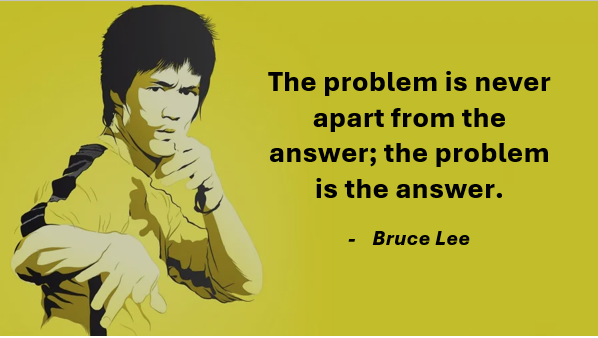
Lanning draws on an observation from Bruce Lee: “The problem is never apart from the answer; the problem is the answer.”
It’s an idea I’ve seen play out repeatedly in business. The challenge keeping you awake at night isn’t always something to eliminate. More often, it’s a signal demanding attention. It highlights a weakness, exposes an opportunity, or forces a decision you’ve been postponing.
In Lanning’s case, declining web traffic prompted a fundamental question: rather than trying to restore the past, what was the market telling him about the future? The issue wasn’t simply falling numbers. It was an opportunity to rethink the business model, refocus priorities and build something more aligned with his goals.
The most successful business owners I’ve worked with don’t ignore these signals, nor do they become paralysed by them. They investigate them and act.
When COVID became a catalyst
In 2020, every business owner faced a problem they hadn’t chosen and couldn’t control.
Supply chains stalled. Revenue streams disappeared. Entire industries were turned upside down. For many owners, survival suddenly became the priority.
At Oasis Partners, we decided to respond rather than retreat. One of the initiatives we launched was the Troubleshooters podcast.
The objective was simple: give business owners access to people who had faced significant setbacks, navigated uncertainty, and emerged stronger. Not polished success stories. Real stories about resilience, adaptation, and growth.
The lesson from those conversations was remarkably consistent. The businesses that emerged strongest weren’t necessarily the ones with the fewest problems. They were the ones that recognised what those problems were telling them and responded decisively.
Adversity became a catalyst for innovation, reinvention and, in many cases, growth.
The problems that shaped everything

Upon reflection, my 1992 business sale taught me far more than any textbook or adviser could have.
In the years that followed I learned the value of competition in a sale process. I learned that confidentiality concerns shouldn’t prevent you from initially exploring potential options. Most importantly, I learned that experience matters.
Those lessons didn’t stay in the past. They directly influenced how I approached future transactions and ultimately led to the creation of Oasis Partners in Australia in 2009.
The problem wasn’t simply something to overcome. It exposed a gap in the market and a gap in my own knowledge. Filling both became the foundation of a business and a way to be constructive.
Shannon Lee captures this idea in her book Be water, my friend. When the old formula stops working, what appears to be a crisis can become an opportunity to reconnect with what matters most and move forward with greater clarity.
A practical challenge for business owners
Lanning also highlights another powerful idea: your problem may be someone else’s solution.
We see this every day in mergers and acquisitions.
A founder may believe their business is too small, too specialised or operating in the wrong geography. Yet a strategic acquirer may view those exact characteristics as highly valuable because they solve a challenge within their own business.
The lesson is simple: don’t assume your weaknesses diminish value. Often they create it.
When a problem emerges, ask yourself three questions:
- What is this issue revealing about my business?
- What opportunity is hidden inside it?
- What action does it require me to take?
The answers can be surprisingly valuable.
After four decades in business, I’ve come to believe that the most important breakthroughs rarely arrive disguised as opportunities. They usually arrive disguised as problems.
The challenge isn’t to avoid adversity. It’s to understand what it’s telling you and act on it.
Because more often than not, the obstacle in front of you isn’t blocking the path forward.
It’s showing you where to go next.
The Troubleshooters podcast is available on all major platforms. If you’d like to explore what your business might be worth to the right buyer, contact the Oasis Partners team.