
- 28 September 2026
- Michael McGrath
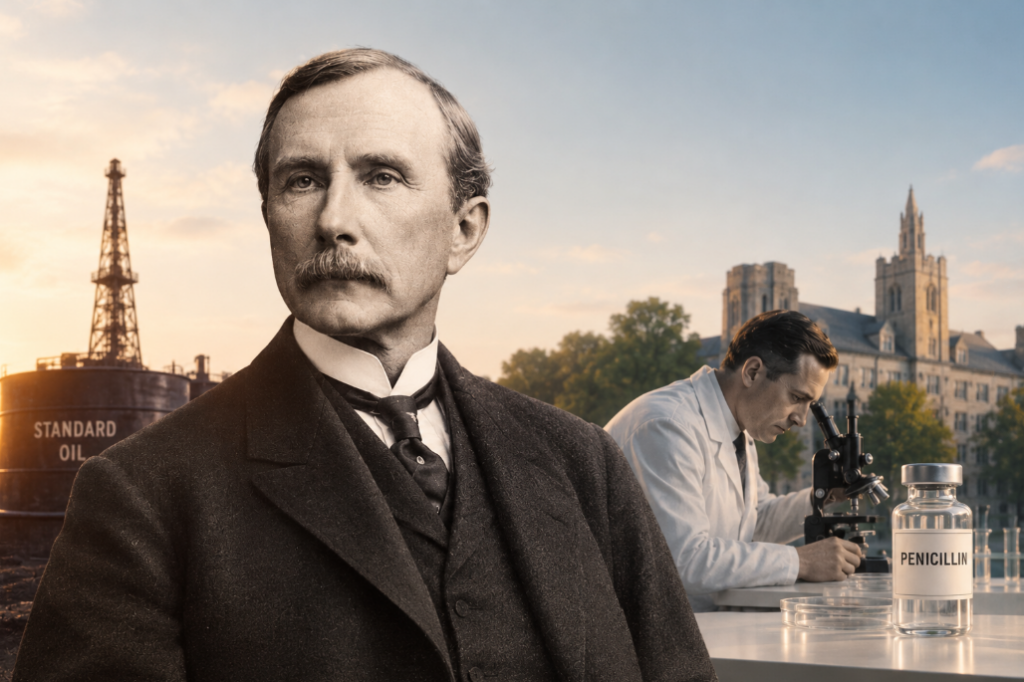
How the world’s first billionaire ended up funding an Adelaide scientist, and what it means for Australia’s $3.5 trillion wealth transfer.
In my last post I argued that freedom is not free, and neither is the free market — that both survive only because societies choose to sustain the institutions that make them possible. I want to test that idea against the life of one man who did more than almost anyone in history to find out what money can, and cannot, buy.
By 1916, American newspapers had already crowned John D. Rockefeller the world’s first dollar billionaire [1]. By 38 he controlled roughly 90 per cent of the oil refined in the United States. By 50 he was America’s richest man, having spent three decades building Standard Oil into the most feared monopoly of the industrial age.
Then, in his early fifties, his body began to fail him. According to Ron Chernow’s biography Titan, Rockefeller lost his hair, developed a severe digestive illness, and endured years of poor health that his physicians feared would kill him giving him just one year to live [2]. The world’s richest man could buy almost anything, yet for a period he could reportedly tolerate little more than the plainest of food. It is one of the more striking ironies in the history of capitalism: total command of markets, and no command at all over his own body.
What followed is the part of the story worth dwelling on. Rockefeller instructed his lawyers and accountants to begin directing his fortune toward hospitals, universities and medical research, founding the Rockefeller Foundation in 1913. Over his lifetime he gave away more than half a billion dollars, a sum worth well over ten billion today [1]. He lived on, by most accounts far more contentedly, until he was 97.
From Standard Oil to penicillin
In 1928, a Scottish bacteriologist named Alexander Fleming noticed that a mould contaminating one of his petri dishes at St Mary’s Hospital in London had killed the surrounding bacteria. It is one of the most famous accidents in the history of science. Fleming named the active compound penicillin, published his observations and, unable to purify or stabilise it, largely set the discovery aside [3].
Turning that accident into a usable medicine fell, a decade later, to a pathologist from Adelaide named Howard Florey. Working at Oxford with the chemist Ernst Chain and researcher Norman Heatley, Florey assembled the team that purified penicillin, tested it, and, as war broke out, raced to mass-produce it. Crucially, that work was financed in 1939 by a grant from the very foundation Rockefeller had established a quarter-century earlier [4].
It is a remarkable chain of custody. Money made from Ohio crude, given away by a man once told he had months to live, ended up funding a South Australian scientist working in a repurposed Oxford laboratory, turning a forgotten accident into the drug that treated Allied soldiers wounded at Normandy and has since saved, on various estimates, somewhere between 200 million and half a billion lives [5]. Florey, Chain and Fleming shared the 1945 Nobel Prize in Medicine for exactly this achievement.
What capitalism bought, and what it cost
None of this excuses everything about how the fortune was made. Standard Oil’s dominance rested on tactics a modern regulator would never tolerate, and the company was broken up by the US Supreme Court as an illegal monopoly in 1911. Capitalism, as I wrote last time, is not a self-correcting moral system. It needs courts, regulators and institutions willing to say no. But it is also, plainly, extraordinarily effective at concentrating capital in one place long enough for someone, eventually, to redirect it toward something markets alone would never have funded.
An Australian born in the 1880s could expect to live to around 47. Someone born today can expect to reach 81, and a woman past 85 [6]. Vaccination, sanitation and nutrition all played their part. So did penicillin and the antibiotics that followed it, which turned once-fatal infections into a short course of tablets. Longer, healthier working lives are, among other things, part of why business owners today are exiting later and structuring succession very differently to clients a generation ago.
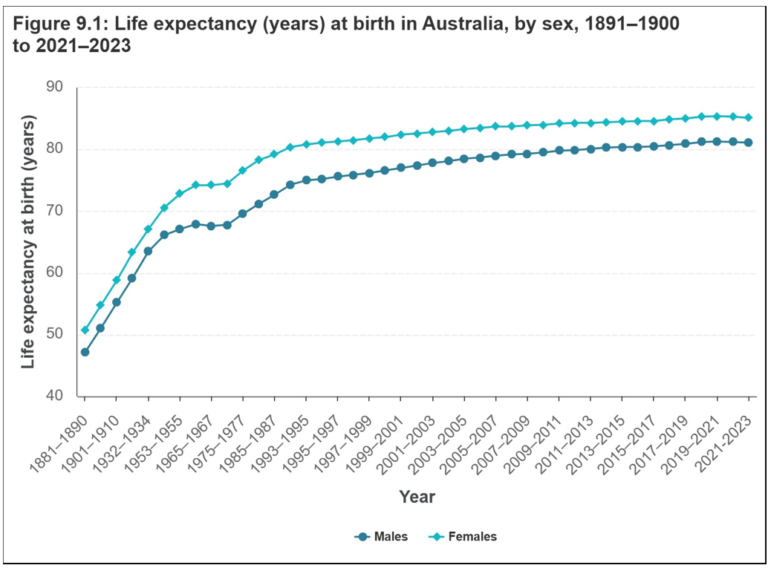
Source: Australian Institute of Health and Welfare, life expectancy at birth in Australia, 1891–2023.
The wealth now coming
Which brings me to why I keep returning to Rockefeller. Australia’s Productivity Commission estimates that around $3.5 trillion will pass from the Baby Boomer generation to their children and grandchildren over the next two decades; globally, the figure most commonly cited is closer to US$68 trillion [7]. It is, by a wide margin, the largest transfer of wealth in human history, and most of it will occur within the working life of everyone reading this — much of it, demographers now suggest, as boomers move through their eighties over the course of the 2030s [8].
Some of that capital will do exactly what Rockefeller’s did: fund research, hospitals and causes markets alone would never prioritise. A good deal of it, history suggests, will simply concentrate further, sit idle in structures built to preserve it, or be gone within two generations for want of planning.
Catholic social teaching has a name for the tension in that choice. The Church’s social doctrine affirms the right to private property while insisting on what it calls the universal destination of goods — the principle that wealth legitimately acquired still carries an obligation toward the common good, and that whoever holds it does so as a steward rather than as an owner in any absolute sense [9].
Rockefeller, an unlikely theologian, seems to have arrived at something close to that idea on his own. In diary entries widely quoted in accounts of his later years, he is said to have written:
“God taught me that everything belongs to Him, and I am merely a conduit to carry out His will.”
[10] A man who had spent his first fifty years mastering the market spent his last forty deciding what it was for.
I don’t think every business owner needs to found a foundation, and I am wary of moralising about how anyone spends wealth they built through their own risk and effort. But as someone who has spent the last twenty years advising people through the single largest financial event of their lives, I would put one modest question to the boomer generation, and to whoever eventually receives their capital: what is it for?
Rockefeller didn’t find an answer until he was staring down a diagnosis. The rest of us might not need to wait that long.
References
[1] Lovemoney, “The incredible story of the world’s first billionaire,” drawing on Forbes’ historical net-worth estimates and detailing the founding of the Rockefeller Foundation (1913) and Rockefeller’s lifetime giving of over $530 million. lovemoney.com
[2] Ron Chernow, Titan: The Life of John D. Rockefeller, Sr. (Random House, 1998), on Rockefeller’s mid-life illness and recovery.
[3] State Library of South Australia, “Innovations: Penicillin,” on Alexander Fleming’s 1928 discovery at St Mary’s Hospital, London. samemory.sa.gov.au
[4] The Nobel Prize, biographical note on Sir Howard Florey, confirming the 1939 grant from the Rockefeller Foundation that financed the Oxford team’s work on penicillin. nobelprize.org
[5] History Hit, “5 Historic Medical Milestones,” and Popular Science, “In 1928, the discovery of ‘mold juice’ would go on to save 500 million lives,” on the development of penicillin at Oxford and estimated lives saved. historyhit.com / popsci.com
[6] Australian Institute of Health and Welfare, life expectancy at birth in Australia by sex, 1891–1900 to 2021–2023.
[7] CPA Australia, InTheBlack, “Great intergenerational wealth transfer explained,” citing the 2021 Productivity Commission estimate of A$3.5 trillion transferring in Australia by 2050, and global estimates of roughly US$68 trillion (A$100 trillion) over 20–30 years. intheblack.cpaaustralia.com.au
[8] Commonwealth Bank, “Baby Boomers’ $3.5 trillion will fund Millennials’ ‘forever homes’,” citing demographer Bernard Salt on Boomers exiting through the 2030s. commbank.com.au
[9] Pontifical Council for Justice and Peace, Compendium of the Social Doctrine of the Church (2004), Chapter Four, III, “The Universal Destination of Goods.” vatican.va
[10] This diary passage is widely circulated in popular and devotional accounts of Rockefeller’s later life.