

Where Things Stand
The deal market remains in good shape as we move further into 2026, despite what most people are predicting as the short-term disruption resulting from the recent geopolitical event in the Middle East. Global deal value reached US$4.9 trillion in 2025, up roughly 40% from 2024, a strong rebound that confirms strategic appetite is back.[1]

Crucially for mid-market participants, headline value growth was concentrated in a small number of very large transactions, which means the mid-market opportunity is less crowded and, in many respects, more attractive than the top-line numbers suggest.[2]
The current mood at this stage in 2026 is constructive but not carefree. 61% of global CEOs expect the economy to improve this year, up from 58% a year ago, enough to support strategic intent without removing the need for care in execution.[3] Tariffs, geopolitics, and a tightening capital pool mean boards are being more selective, not less active, and that selectivity tends to favour quality mid-market businesses over large speculative plays.[4]
The mid-market is where the real action is in 2026. While attention gravitates to headline-grabbing transactions, the bulk of deal volume, and much of the best value creation, happens in established private businesses with defensible niches, sticky customers, and owners thinking about succession and their next chapter. Private equity dry powder remains at historic highs and therefore, needs to find a home. Strategic buyers are hunting for capability and market access shortcuts. Quality mid-market assets, intelligently matched, are in genuine demand.[2][5][6]
Geopolitics
The single biggest change in the 2026 deal environment is that geopolitical and trade policy risk has moved from background noise to front-page policy. It is no longer enough to price and structure a transaction well; you also have to be certain that the strategic fit and upside, warrant moving through due diligence together with the risks of merging.[7]
Trump tariffs and ‘Liberation Day’
The US administration’s sweeping tariff actions in early 2025, including the so-called ‘Liberation Day’ announcements, delivered a sharp shock to deal confidence in the first half of the year.[8] M&A volumes contracted, processes were paused, and boards waited for policy clarity. The market recovered strongly in Q3 and Q4, but the episode reinforced a permanent shift: deal teams are now highly sensitive to potential tariff exposure resulting from a merger; this is likely to show up in the way deals are structured, where MAC (material adverse change) provisions seek to find their way into purchase agreements. [7]
Cross-border M&A

Cross-border deals remain a strong feature of the M&A landscape. At Oasis Partners, 50% of our deals have an overseas element; however, the calculus is more complex for buyers. Governments are increasingly using FDI (foreign direct investment) review regimes and antitrust powers as policy tools, not just competition safeguards. Foreign buyers from non-allied jurisdictions face harder paths through approval. Even buyers from friendly countries are being scrutinised more closely in sensitive sectors.[7] The practical result: domestic and friendly-corridor transactions are being prioritised, while large cross-border transactions face the greatest friction and longest timelines. Most international deals at Oasis Partners are with North American and European corporate buyers, although we saw our first mainland Chinese acquisition late last year.
Critical minerals, defence and data: the hot zones
Sectors framed as geopolitically strategic — critical minerals, infrastructure, defence, energy and data-rich industries are attracting concentrated deal activity globally but also the sharpest regulatory attention.[7} Supply chain resilience has become a genuine acquisition rationale: buyers are paying for assets that reduce exposure to tariff-vulnerable inputs or that anchor regionalised operating models.
Australia: A More Complex But Still Attractive Market
Australia’s deal market followed a steadier path than the global rebound: total deal value reached US$79.5 billion in 2025, down 8% on 2024, with volume easing to 1,285 transactions.[5] That said, 52% of Australian CEOs plan major acquisitions in the next three years, and the pipeline is building, particularly in energy, financial services, resources, and mid-market services.[5]
The new regulatory reality
2026 opens with the most significant changes to Australia’s merger framework in decades. From 1 January 2026 we saw, mandatory and suspensory ACCC clearance regime is in force: transactions meeting defined thresholds must be notified and cleared before completion, effectively meaning virtually all public M&A bids require ACCC approval.[9] We have seen two transactions in the last six months require ACCC approval – routine but costly in terms of time delays. Add to this FIRB’s increasingly active and conditional approach, and the message is clear: regulatory planning is now a deal design activity, not an afterthought. Expect longer timelines and more conditions. The recent failed FIRB approval for a Chinese government-backed renewables developer seeking TPC Consolidated, after 18 months of process, is an instructive case. [9]
Australia’s geopolitical positioning: both risk and opportunity
Australia’s alliance with the US and its resource endowment are creating deal opportunities that didn’t exist two years ago. The US-Australia Framework for Securing Supply in Critical Minerals and Rare Earths, signed in October 2025, is already prompting US investor interest in Australian lithium, copper, rare earths and battery metals assets.[10] FIRB approvals are flowing faster for investors from ‘like-minded’ countries. Conversely, Chinese-backed investment faces a materially tougher path, particularly in minerals, infrastructure and technology.
Japanese investment is a standout emerging theme. Nine percent of Japanese CEOs plan to invest in Australia in the next 12 months, nearly double the US equivalent, with focus on energy, infrastructure and quality mid-market assets.[5]
The mid-market: where the deals are getting done
Australia’s mid-market is the most active and consequential part of the deal landscape in 2026, and it is showing real momentum. We note significant activity picking up across the mid-market, driven by succession planning, intergenerational wealth transfer, private equity dry powder deployment, and founders reassessing their options in a rapidly changing operating environment. [6]
 Supply is genuine. Owner-operators who built businesses over 15–25 years are reaching natural transition points. Many are not distressed sellers; they are thoughtful owners who want the right outcome, not just a quick exit. That dynamic rewards patient, well-prepared processes and buyers who can articulate a credible vision for the business beyond day one.
Demand is real and competitive. Private equity sponsors are sitting on record levels of undeployed capital and face mounting pressure to put it to work.[5] Strategic buyers are actively hunting for capability shortcuts: acquiring market access, customer relationships, specialised teams or technology that would take years to build organically. In the current environment, a well-positioned mid-market business with a clear strategic logic can attract genuine competitive tension , driving the best outcomes for sellers. What we think is necessary is the continuation and the growth in flexibility of private equity firms as they look at smaller assets in the mid-market who will never tick all their boxes but nevertheless represent opportunities for smart capital. The increase in the numbers of Private Equity buy-hold players is encouraging.
Key Themes Shaping 2026 Deals
AI drives strategic urgency
AI is accelerating corporate transformation timelines, pulling forward M&A decisions on scale, data, and capability. This is less about buying anything labelled ‘AI’ and more about acquiring the infrastructure, workflow and talent needed to compete. Heavy AI capital expenditure by hyperscalers — averaging US$760 million per day in the US in 2025 — is reshaping deal rationale across tech, industrials and energy.[12]
Portfolio reshaping creates deal supply
Carve-outs, asset separations and non-core divestitures are a growing source of quality assets coming to market as large corporates refocus around their strongest positions.[3]
Private credit is changing deal financing
Alternative capital, including private credit, co-investment, insurance capital and private capital, is increasingly filling gaps left by bank debt. This broadens the buyer universe and enables structures that weren’t practical two years ago.[13]
Earn-outs and minority stakes bridge valuation gaps
Not every outcome needs to be a clean 100% sale. In practice, we still see 50% cash deals. However, in the right circumstances there are opportunities for vendors in structuring a deal, especially when merger leverage will drive future upside and that gets baked into the terms. Staged acquisitions, minority positions and earn-outs are increasingly part of the landscape and can help to bridge the inevitable valuation gaps. When structured fairly, these structured deals are becoming more acceptable to both sides.
Cyber and data posture affects deal terms
Security maturity increasingly affects diligence intensity, customer requirements and downside risk, even when the business isn’t a ‘tech company’.
Who Buys and Why It Determines What You Get
Strategic buyers: why they matter most in the mid-market
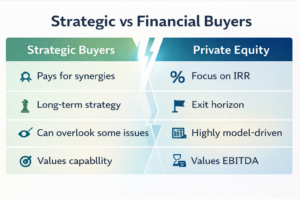
The most important insight for mid-market sellers in 2026 is this: the type of buyer matters and significantly effects the price on the term sheet. Strategic and financial buyers are operating from fundamentally different starting points, and that difference has direct consequences for valuation, deal certainty, and what happens after the deal closes.
Financial buyers (private equity) are price-disciplined by nature. They need a return on invested capital, they model everything from the bottom up, and they get stuck on issues that don’t fit their model. A customer concentration problem, a lease coming up for renewal, or an earn-out dependency on a key person can kill a financial buyer’s conviction quickly. Their diligence process is designed to find reasons to reprice or walk. That is not a character flaw: it is the job of a banker.
Strategic buyers work differently. They are buying a future, not underwriting a spreadsheet. A strategic acquirer who genuinely needs your customer relationships, your team, your distribution network, or your market position or IP will look past issues that stop a financial buyer cold, because those issues don’t change the strategic logic of the deal. McKinsey’s latest analysis confirms this: strategic buyers are increasingly willing to pay for synergies (cost, revenue and capability), and the most active strategic acquirers consistently outperform on total shareholder return precisely because they are buying with conviction, not just capital.[14]
In 2026, we are seeing more strategic buyers entering the market with renewed urgency around AI, capability gaps, supply chain resilience and market access; the window to find a buyer with genuine strategic conviction is open. Mid-cap corporates are actively hunting mid-market targets that accelerate their strategy, with 46% doing so.[15] Inbound interest from Japan and the US is at elevated levels. The conditions that produce a motivated strategic buyer are, right now, genuinely favourable.
The question for owners is not ‘is my business ready for a process?’ but rather ‘who has the most to gain from owning what I have built?’ Finding the right strategic buyer is never easy, and rarely a five-minute job. However, once identified and correctly qualified, the conditions emerge for them to pay a strategic premium, for a business which has the features they have identified in their acquisition criteria. This is where value is both unlocked and created by the new owner.